
Does Illinois Have Common Law Marriage?
Legally reviewed by Allen S. Gabe, Family Law Attorney
Illinois abolished common law marriage in 1905, and the rule is codified in state law at 750 ILCS 5/214. It does not matter how long you and your partner have lived together, seven years, twenty years, or fifty years. No amount of cohabitation creates a marriage in Illinois. The only way to be legally married in this state is to obtain a marriage license and have the marriage solemnized and registered with the county clerk.
Practically speaking, this means an unmarried partner in Illinois has no automatic rights to property division, inheritance, or spousal support if the relationship ends or one partner passes away.
This affects more couples every year. According to data from the National Center for Family and Marriage Research, roughly 20.3 million U.S. adults were living with an unmarried partner as of 2024, up from 14 million in 2009, and about four out of five recent marriages began with the couple living together first. Every one of those couples in Illinois is building a life without the automatic legal protections that married couples take for granted.
What Is Common Law Marriage?
A common law marriage is a legally recognized marriage formed without a formal ceremony or marriage license. In states that allow it, a couple becomes married by living together and holding themselves out to the community as spouses, referring to each other as husband or wife, filing joint tax returns, or sharing a last name.
One persistent myth deserves to be cleared up: no state has an automatic rule that a couple becomes married after a certain number of years together. The “seven-year rule” you may have heard about does not exist anywhere in the United States. In states that recognize common law marriage, the typical requirements are a mutual agreement to be married, cohabitation, and publicly presenting yourselves as a married couple. Time together is rarely the deciding factor.
So why does any of this matter to Illinois residents? Because people move. If you established a valid common law marriage in another state and later relocated to Illinois, your marital status may follow you here, a point we cover in more detail below.
When Did Illinois Stop Recognizing Common Law Marriage?
Illinois abolished common law marriage effective June 30, 1905, more than 120 years ago. Since then, Illinois courts have consistently upheld the rule that a cohabiting couple does not acquire the rights of a legally married couple, no matter how long the relationship lasts.
The governing statute is 750 ILCS 5/214, part of the Illinois Marriage and Dissolution of Marriage Act, which provides that common-law marriages contracted in Illinois after June 30, 1905, are invalid.
Illinois was ahead of a national trend. Most states have since moved away from common law marriage, some quite recently. Alabama, for example, abolished it for relationships formed on or after January 1, 2017.
Which States Still Recognize Common Law Marriage?
A small number of jurisdictions still allow couples to form a common law marriage today, including:
- Colorado
- Iowa
- Kansas
- Montana
- New Hampshire (for inheritance purposes only)
- Oklahoma
- Rhode Island
- South Carolina (for marriages formed before July 24, 2019)
- Texas
- Utah (requires a court order validating the marriage)
- The District of Columbia
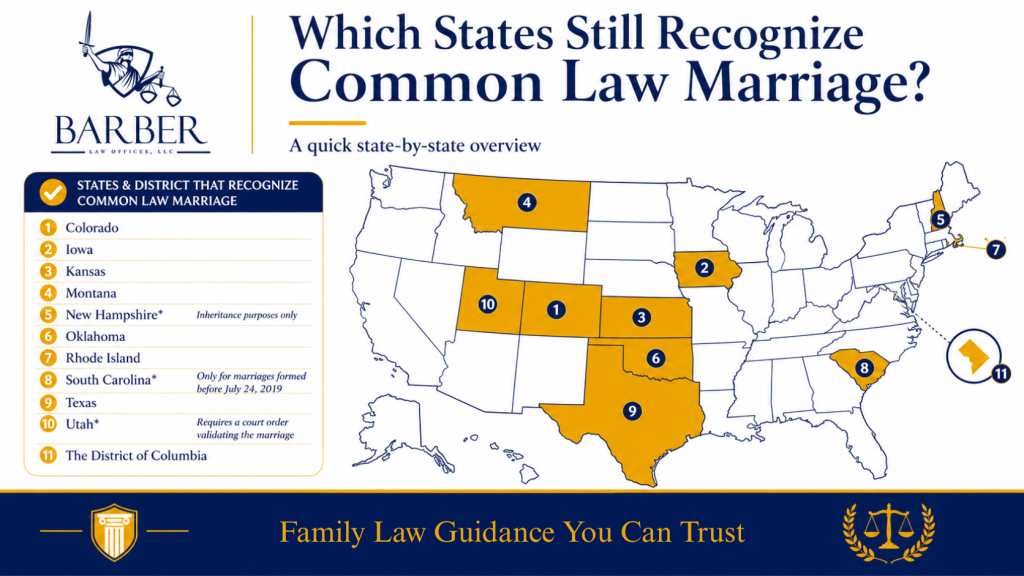
The rules vary considerably from one state to the next. Some impose strict requirements or recognize common law marriage only in limited circumstances, such as at death for inheritance purposes.
Here is where this becomes relevant for Illinois residents: if you validly established a common law marriage in one of these states and then moved to Illinois, Illinois courts may recognize that marriage. But the burden of proving it falls on you, and the proof requirements are high.
Does Illinois Recognize Common Law Marriages From Other States?
Yes, in principle. Under the Full Faith and Credit Clause of the U.S. Constitution, Illinois courts can recognize a common law marriage that was validly formed under another state’s laws before the couple moved here. A common law marriage that was valid where it was created is just as binding as a licensed, ceremonial marriage, including the fact that it must be ended through divorce.
In practice, proving one of these marriages is difficult. There is no license, no certificate, and often no paperwork at all. Courts will look at evidence such as:
- Shared bank accounts and commingled finances
- Joint federal or state tax returns filed as a married couple
- How the couple referred to each other publicly and in documents
- Joint ownership of property or vehicles
- Insurance policies or benefits listing the partner as a spouse
Without strong documentation, these cases often come down to conflicting testimony. If you believe you formed a common law marriage in another state before moving to Illinois, whether you are trying to establish it or defend against a claim of one, speak with a family law attorney before taking any other steps.
Can an Unmarried Partner Sue for Property Rights in Illinois?
Illinois courts have answered this question twice, decades apart, and the answer both times was no.
In Hewitt v. Hewitt (1979), the Illinois Supreme Court refused to divide property between a couple who had lived together for 15 years and raised three children. The court reasoned that granting marriage-like rights to unmarried partners would effectively revive common law marriage, which the legislature abolished in 1905.
Nearly four decades later, in Blumenthal v. Brewer (2016), the court reaffirmed that rule. The case involved two professionals who shared a home and finances for more than 25 years. When the relationship ended, one partner sought an interest in the other’s medical practice. The Illinois Supreme Court rejected the claim, holding that state public policy still bars unmarried partners from bringing property claims that depend on their relationship.
The practical takeaway: Illinois courts will not create marriage rights after the fact, no matter how long the relationship lasted or how intertwined the finances became. Protections for unmarried couples have to be put in writing while the relationship is intact.
What Legal Rights Do Unmarried Couples Have in Illinois?
Because Illinois does not recognize common law marriage, unmarried couples have far fewer automatic legal protections than married couples. Here is a side-by-side look at how the two compare, followed by a closer breakdown of each area.
| Legal Protection | Married Couples | Unmarried Couples | Unmarried Couples With Agreements in Place |
|---|---|---|---|
| Property division at breakup | Automatic, equitable distribution under Illinois law | None. Name on the deed, title, or account controls | Divided per the cohabitation agreement |
| Inheritance without a will | Surviving spouse inherits under intestate succession | Nothing. Assets pass to blood relatives | Partner inherits through a will, trust, or beneficiary designations |
| Medical decisions if incapacitated | Spouse is typically consulted as next of kin | No automatic authority. Hospitals turn to blood relatives | Partner decides under a healthcare power of attorney |
| Spousal support after separation | Available through divorce proceedings | None. Palimony claims are barred in Illinois | Only if the cohabitation agreement provides for it |
| Child support and parenting time | Available | Available, once parentage is established | Available, once parentage is established |
Property Rights
There is no “marital property” between unmarried partners, so there is no automatic division of shared assets when the relationship ends. Generally, whoever’s name is on the deed, title, or account keeps the asset, even if the other partner contributed to the mortgage, made improvements, or paid household expenses for years.
A cohabitation agreement can change this outcome by contract, spelling out in advance how jointly acquired property will be divided.
Inheritance
An unmarried partner has no automatic inheritance rights in Illinois. If your partner dies without a will, Illinois intestate succession laws pass their assets to blood relatives, including children, parents, and siblings, and the surviving partner receives nothing, regardless of how long the relationship lasted.
The only protection is proactive estate planning: a valid will or trust naming your partner, along with beneficiary designations on life insurance policies and retirement accounts.
Children and Parental Rights
Children born to unmarried parents have the same legal rights as children born within a marriage, including the right to child support from both parents. The key difference is that paternity must be legally established for an unmarried father, either through a Voluntary Acknowledgment of Paternity or a court order.
Once parentage is established, child custody (called allocation of parental responsibilities in Illinois) and child support are handled under the same laws that apply to divorcing couples. Marital status has no bearing on these matters.
Medical and Emergency Decisions
An unmarried partner has no automatic right to make medical decisions for you if you become incapacitated. Hospitals will typically turn to your next of kin, including parents, adult children, or siblings, not your partner, no matter how long you have been together.
A healthcare power of attorney is essential for unmarried couples. A durable power of attorney for property is equally important, allowing your partner to manage financial matters on your behalf if you cannot.
Does Illinois Offer an Alternative to Common Law Marriage?
Yes. Illinois recognizes civil unions under the Illinois Religious Freedom Protection and Civil Union Act, in effect since June 1, 2011. A civil union gives both partners the same rights and obligations that Illinois law provides to spouses, including property division, inheritance rights, and medical decision-making authority. It is available to both same-sex and opposite-sex couples.
Unlike a common law marriage, a civil union requires a license from the county clerk and certification by an authorized official. One important limitation: federal benefits tied to marriage, such as Social Security spousal benefits and joint federal tax filing, do not extend to civil unions.
For couples who want the legal protections of marriage under Illinois law without a marriage itself, a civil union is the formal path the state provides.
The Alternative for Couples Who Stay Unmarried: Illinois Cohabitation Agreements
For couples who choose not to marry, a cohabitation agreement is the closest Illinois offers to the protections of marriage. It is a legally binding contract between unmarried partners that establishes each person’s rights and obligations both during the relationship and if it ends.
A cohabitation agreement can address:
- How property acquired together will be divided if you separate
- Responsibility for shared debts, including a joint mortgage or car loan
- Whether one partner will provide financial support to the other after a breakup
- Ownership of the home and what happens to it if the relationship ends
What it cannot do is determine child custody or child support. Those matters are governed by Illinois family law based on the best interests of the child, and no private contract can override them.
In function, a cohabitation agreement works much like a prenuptial agreement; it just doesn’t require a marriage. And after Hewitt and Blumenthal, it is not optional protection. It is the only property protection Illinois courts will enforce between unmarried partners. For a couple planning to buy a home together, commingle finances, or build a life without a marriage license, it is often the single most important legal document they can sign.
Frequently Asked Questions
How long do you have to live together to be common law married in Illinois?
No amount of time creates a common law marriage in Illinois. The state abolished common law marriage in 1905, so a couple could live together for 50 years and still not be legally married. The only paths to spousal rights in Illinois are a licensed marriage or a civil union.
Is Illinois a common law property state?
No. Illinois is an equitable distribution state, meaning courts divide marital property fairly between divorcing spouses. That framework only applies to married couples and civil union partners. Unmarried partners receive no property division at all, no matter how long the relationship lasted.
Can you get palimony in Illinois?
No. The Illinois Supreme Court barred support and property claims between unmarried partners in Hewitt v. Hewitt (1979) and reaffirmed that rule in Blumenthal v. Brewer (2016). The only enforceable claims between unmarried partners are based on a written contract, such as a cohabitation agreement.
Does Illinois recognize domestic partnerships?
Illinois has no statewide domestic partnership registry. The statewide option for unmarried couples seeking spousal rights is a civil union, which has been available since June 1, 2011 and provides the same state-level rights and obligations as marriage.
Protect Your Rights, Married or Not
Whether you are ending a long-term relationship, sorting out property with a former partner, or trying to establish that a common law marriage from another state should be recognized here, the stakes are real and the law is unforgiving of assumptions. The experienced divorce and family law attorneys at Barber Law Offices have represented clients throughout Schaumburg and the Chicagoland area since 1984, and we can help you understand exactly where you stand and what to do about it.
Call 847-303-9780 or contact us online to schedule a free consultation.

Allen Gabe is an experienced Illinois attorney specializing in family law, bankruptcy, and real estate matters. With over 50 years of experience, he has helped countless clients navigate divorce, child custody, debt relief, and complex legal challenges with compassion and expertise. Recognized for his dedication, Allen has received multiple awards for client satisfaction and is an active member of professional and community organizations in the Chicago suburbs.

