
What Are the Grounds for Divorce in Illinois? 2026 Guide
Illinois is a no-fault divorce state, which means you do not have to prove that your spouse cheated, abused you, abandoned you, or otherwise did something wrong to obtain a divorce. Under 750 ILCS 5/401 the only legal ground for divorce in Illinois is that irreconcilable differences have caused the irretrievable breakdown of the marriage.
For spouses considering divorce in Schaumburg, Cook County, and the surrounding northwest suburbs, this distinction is important. Much of the information available online about Illinois divorce grounds is outdated and describes fault-based grounds that Illinois eliminated effective January 1, 2016.
This guide explains the current grounds for divorce in Illinois, how the state’s no-fault system works, whether adultery or other misconduct can still matter, whether you have to be separated before getting divorced, and what to know before filing for divorce. In addition to this article, an Illinois divorce attorney can help you understand how these rules apply to your circumstances.
What Are the Grounds for Divorce in Illinois?
Illinois has one ground for divorce: irreconcilable differences that have caused the irretrievable breakdown of the marriage.
Under 750 ILCS 5/401, the court must determine that irreconcilable differences have caused the marriage to break down and that efforts at reconciliation have failed or that further attempts at reconciliation would be impracticable and not in the best interests of the family. In practical terms, Illinois courts do not require spouses to prove who was responsible for the marriage ending. The focus is on whether the legal requirements for dissolution have been met and, when applicable, resolving issues involving property, support, and children.
The legal term used by Illinois courts is dissolution of marriage, although most people simply call it divorce. For purposes of everyday conversation and most online searches, the terms mean the same thing.
Is Illinois a No-Fault Divorce State?
Yes. Illinois is a no-fault divorce state.
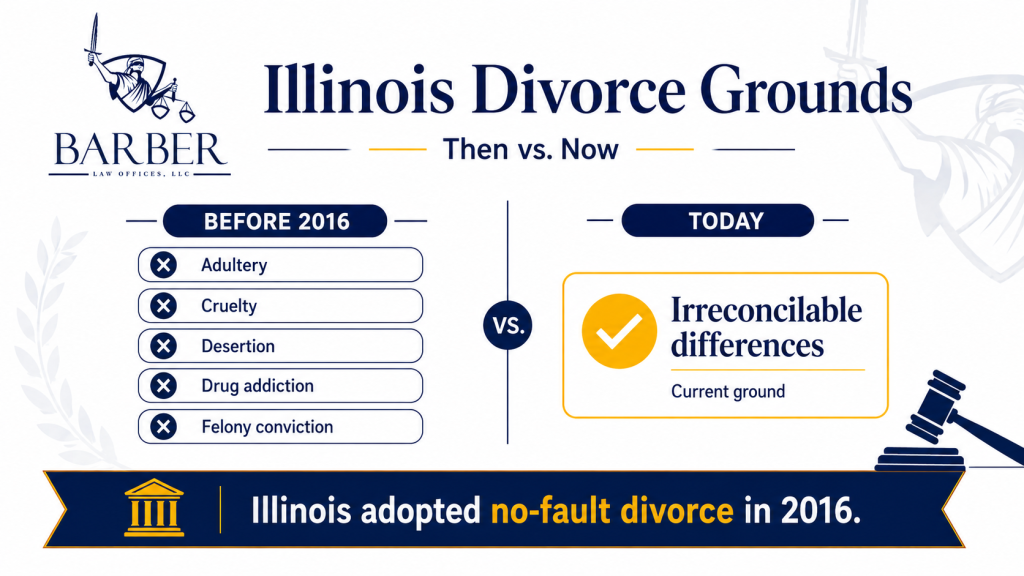
Since January 1, 2016, Illinois has recognized irreconcilable differences as the sole ground for dissolution of marriage. The change eliminated the former system in which a spouse could seek a divorce by proving specific misconduct by the other spouse.
Under Illinois’ current system, you generally do not have to prove:
- Adultery
- Physical cruelty
- Mental cruelty
- Abandonment
- Desertion
- Habitual drunkenness
- Drug addiction
- A felony conviction
- Other marital misconduct
Instead, the legal question is whether irreconcilable differences have caused the irretrievable breakdown of the marriage.
What Does “No-Fault Divorce” Mean?
A no-fault divorce does not mean that a spouse’s conduct can never matter during a divorce. It means that misconduct is not required to establish legal ground for dissolving the marriage. For example, a spouse’s affair is not a ground for divorce. However, if that spouse spent substantial marital funds on the affair, those expenditures could potentially become relevant to dissipation of marital assets. Similarly, conduct that creates a genuine safety concern for a child may be relevant when the court addresses parental responsibilities and parenting time.
The distinction is important: misconduct does not determine whether the marriage can be dissolved, but certain conduct can still affect other issues in a divorce case
What Were the Old Fault Grounds for Divorce in Illinois?
Before January 1, 2016, Illinois recognized a number of fault-based grounds for divorce. A spouse generally had to establish a specific statutory ground to obtain a divorce.
Older Illinois divorce information may therefore refer to grounds such as:
- Adultery
- Mental cruelty
- Physical cruelty
- Desertion
- Habitual drunkenness
- Drug addiction
- Bigamy
- Conviction of a felony
- Knowingly infecting a spouse with a sexually transmitted disease
Those are not current grounds for divorce in Illinois.
Is Adultery a Ground for Divorce in Illinois?
No. Adultery is not a ground for divorce in Illinois. A spouse does not have to prove that the other spouse cheated to obtain a divorce. Likewise, a spouse generally cannot prevent the divorce simply by disputing an allegation of infidelity.
However, people who search for “adultery and divorce in Illinois” are often asking a second question: Does cheating affect anything else in the divorce? Potentially, yes:
- Dissipation of marital assets: If a spouse spent marital money on an affair, gambling, or other purposes unrelated to the marriage while it was breaking down, that spending can be raised during property division. Illinois divides marital property equitably, and a judge can account for money that was wasted.
- Children’s safety: Dangerous, abusive, or neglectful behavior is relevant to the allocation of parental responsibilities and parenting time. The court’s focus there is the best interests of the child, not punishing a parent, but genuine safety concerns carry weight.
While misconduct does not decide whether you get divorced, it can influence how money and parenting are handled once you are.
Do You Have to Be Separated to Get a Divorce in Illinois?
There is a lot of confusion about a “separation period,” so here is the precise version. If both spouses agree the marriage is irretrievably broken, there is no waiting period and no separation requirement. You do not have to live apart for any set time.
If one spouse contests the grounds, living separate and apart for a continuous period of six months creates an irrebuttable presumption that irreconcilable differences exist (750 ILCS 5/401(a-5)). “Irrebuttable” means once you hit six months, the other spouse cannot argue the marriage is still salvageable. It settles the question of grounds.
The detail people miss: “separate and apart” does not require separate addresses. Spouses can live under the same roof and still be separate and apart if they are no longer functioning as a married couple. That matters for families who cannot afford two households while a case is pending.
If you are weighing your options here, our guide on divorce versus legal separation in Illinois walks through the difference.
What Happens After You Establish the Grounds for Divorce?
Once the legal requirements for dissolution are met, the divorce case still needs to address the issues that will determine the terms of the final judgment.
Depending on the circumstances, these may include:
- Filing the petition for dissolution. The case begins when the appropriate divorce documents are filed with the court.
- Notifying the other spouse. The other party must receive the legally required notice of the case.
- Identifying marital and non-marital property. Assets and debts may need to be identified, classified, valued, and divided.
- Addressing maintenance. If applicable, the spouses may need to resolve whether spousal maintenance should be awarded.
- Addressing parenting issues. When children are involved, the parents may need to establish parental responsibilities, parenting time, and child support.
- Resolving disputes. The parties may reach an agreement, use mediation, or ask the court to decide contested issues.
- Entering the judgment of dissolution. Once the necessary issues have been resolved, the court can enter the final judgment.
The Illinois statute specifically requires the court to address or make appropriate provision for issues including parental responsibilities, child support, maintenance, and disposition of property before entering a judgment of dissolution, subject to the circumstances described in the statute.
For more information about the overall process, see our guide to the Illinois divorce process.
Grounds for Annulment vs. Divorce in Illinois
Divorce and annulment are not the same legal process. In Illinois, what people commonly call an annulment is formally known as a declaration of invalidity of marriage. Unlike a divorce, which ends a legally valid marriage, a declaration of invalidity is based on specific circumstances in which the marriage was legally invalid or subject to being declared invalid.
Under 750 ILCS 5/301, grounds for a declaration of invalidity can include circumstances involving:
- Lack of capacity to consent because of mental incapacity or infirmity
- Incapacity caused by alcohol, drugs, or another incapacitating substance
- Consent obtained through force or duress
- Certain fraud involving the essentials of marriage
- Physical incapacity to consummate the marriage when the other spouse did not know about it
- Certain marriages involving a 16- or 17-year-old without required consent or judicial approval
- A prohibited marriage
The time limits for seeking a declaration of invalidity can also differ depending on the specific ground. Because annulments have specific legal requirements and deadlines, someone considering this option should have an attorney evaluate the circumstances before deciding whether to pursue a declaration of invalidity.
What Does This Mean for Spouses in Schaumburg and Cook County?
For someone considering divorce in Schaumburg or the surrounding northwest suburbs, the most important takeaway is that you do not need to build your divorce case around proving that your spouse was at fault.
Instead, the legal and financial questions often become more practical:
- What property is marital?
- How should marital assets and debts be divided?
- Is spousal maintenance an issue?
- What parenting arrangement is in the children’s best interests?
- How should parenting time be structured?
- Is there a potential dissipation claim?
- Can the spouses reach an agreement?
- What happens if they cannot agree?
The answer to these questions depends on the individual circumstances of the marriage. Barber Law Offices, LLC represents clients in divorce and family law matters in Schaumburg and throughout the surrounding northwest suburban communities and counties, including Cook, DuPage, Kane, Lake, and McHenry Counties.
Talk to a Schaumburg Divorce Attorney
 Knowing that Illinois is no-fault is the easy part. Applying it to your marriage, your finances, and your children is where the real questions come up, and those answers depend on your specific situation and the county you file in.
Allen S. Gabe has represented Illinois families in divorce and family law matters for more than 30 years, with courtroom experience across Cook, DuPage, Kane, Lake, and McHenry Counties. Barber Law Offices, LLC serves Schaumburg and the surrounding northwest suburbs.
Call 847-303-9780 or request a confidential consultation online to talk through your options.
Grounds for Divorce FAQs
What are the grounds for divorce in Illinois?
Illinois recognizes one ground for divorce: irreconcilable differences that have caused the irretrievable breakdown of the marriage, under 750 ILCS 5/401. You cannot file on fault grounds like adultery or cruelty, because the state removed those in 2016. One spouse asserting that the marriage is broken is generally enough for a court to proceed.
Is Illinois a no-fault divorce state?
Yes. Since January 1, 2016, Illinois has been a pure no-fault divorce state. Irreconcilable differences is the only legal ground, and neither spouse has to prove the other did something wrong. Courts no longer assign blame for a failed marriage, which usually keeps the focus on children, support, and dividing property.
Does adultery matter in an Illinois divorce?
Adultery is not a ground for divorce in Illinois and does not affect whether the divorce is granted. It can matter indirectly in two situations: if a spouse spent marital money on an affair, which can affect property division as dissipation, and if the conduct raises genuine concerns about the children’s safety.
How long do you have to be separated to divorce in Illinois?
There is no separation requirement if both spouses agree the marriage is irretrievably broken. If one spouse contests the grounds, living separate and apart for six months creates an irrebuttable presumption of irreconcilable differences. “Separate and apart” can include living under the same roof while no longer acting as a married couple.
Do both spouses have to agree to divorce in Illinois?
No. Illinois does not require both spouses to agree. One spouse can obtain a divorce even if the other objects. If the other spouse contests that the marriage is broken, the six-month separation period establishes the grounds. A spouse cannot block a divorce simply by refusing to participate.
What is the residency requirement for divorce in Illinois?
At least one spouse must have lived in Illinois for 90 days before the court enters the judgment, under 750 ILCS 5/401. Military members stationed in Illinois for 90 days also qualify. There is no waiting period to file the petition; the 90 days apply to finalizing the divorce.

Allen Gabe is an experienced Illinois attorney specializing in family law, bankruptcy, and real estate matters. With over 50 years of experience, he has helped countless clients navigate divorce, child custody, debt relief, and complex legal challenges with compassion and expertise. Recognized for his dedication, Allen has received multiple awards for client satisfaction and is an active member of professional and community organizations in the Chicago suburbs.

