
What Are the Different Types of Divorce in Illinois?
If you are considering divorce in Illinois, you may come across terms such as contested divorce, uncontested divorce, no-fault divorce, joint simplified divorce, and default divorce. These terms can be confusing because they do not all describe the same thing. Some describe the legal basis for divorce, some describe how spouses proceed through the divorce process, and others describe how disagreements are resolved.
The Illinois divorce attorneys at Barber Law Offices have handled Chicagoland divorce cases since 1984, from straightforward agreed filings to complex, high-conflict litigation. Understanding the differences can help you determine what type of divorce process may apply to your situation.
Key Takeaways
- Illinois has one legal ground for divorce, irreconcilable differences, so the “type” of divorce you have describes how your case is handled, not why the marriage is ending.
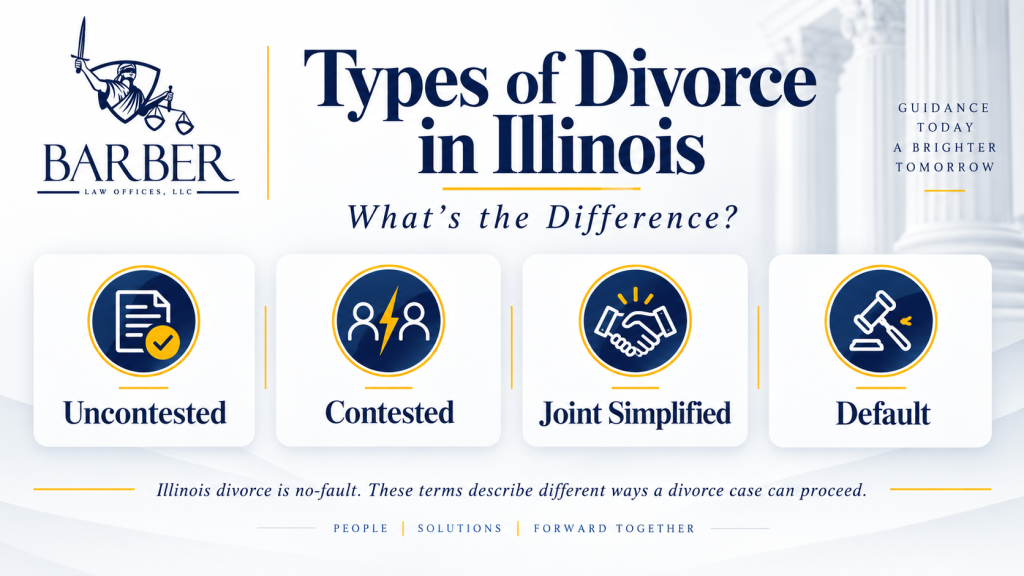
- The four procedural paths are uncontested divorce, contested divorce, joint simplified dissolution, and default divorce.
- No-fault and uncontested are not the same thing. Every Illinois divorce is no-fault, and plenty of no-fault cases are heavily contested.
- Joint simplified dissolution under 750 ILCS 5/452 has strict income, property, and marriage-length limits, so most couples do not qualify.
- Contested cases usually settle. Negotiation, mediation, and collaborative divorce all resolve disputes without a trial.
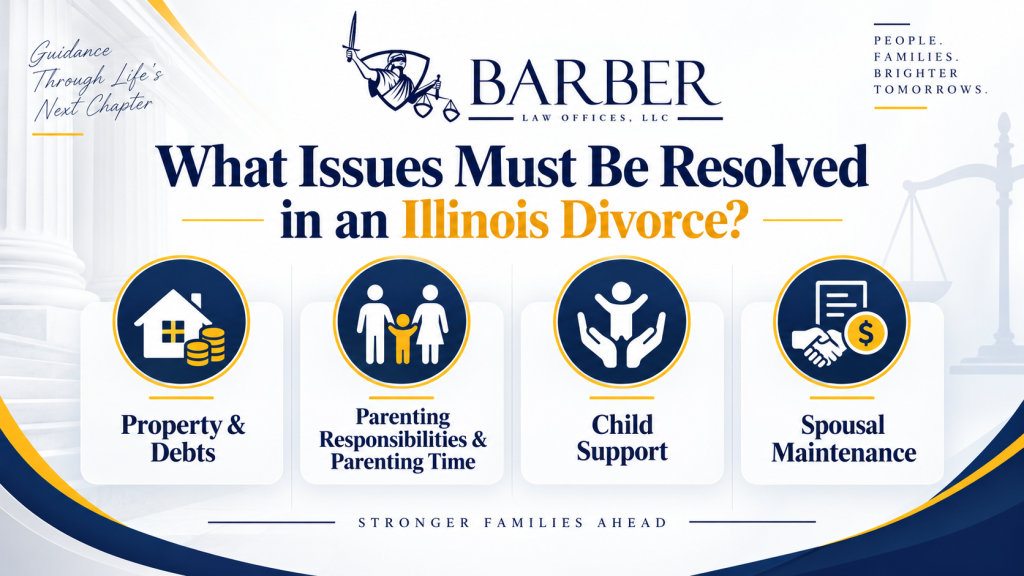
- The same four issues must be resolved either way: property and debts, parenting, child support, and maintenance.
- One attorney cannot represent both spouses, even when the two of you agree on everything.
How Many Types of Divorce Are There in Illinois?
There is not one official list that divides every Illinois divorce into a fixed number of “types.” Instead, it is helpful to understand Illinois divorce in three different ways:
1. The legal basis for divorce
Illinois uses irreconcilable differences as the basis for dissolution of marriage. Illinois does not require a spouse to prove adultery, abandonment, cruelty, or another form of marital misconduct to obtain a divorce.
2. How the divorce proceeds
The case may proceed as:
- Uncontested or agreed
- Contested
- Joint simplified
- Default
3. How disagreements are resolved
Spouses may use:
- Negotiation
- Mediation
- Collaborative divorce
- Litigation
This distinction is important because an uncontested divorce and a mediated divorce are not necessarily two different types of divorce. Mediation is a method for reaching an agreement, while uncontested describes the level of agreement between the spouses.
Is Illinois a No-Fault Divorce State?
Yes. Illinois is a no-fault divorce state. Under Illinois law, a marriage may be dissolved when the spouses have irreconcilable differences. Illinois does not require one spouse to prove that the other spouse was responsible for the breakdown of the marriage.
What Does “No-Fault Divorce” Mean?
A no-fault divorce means you generally do not need to prove that your spouse:
- Cheated
- Abandoned you
- Was cruel
- Committed another form of marital misconduct
Instead, the focus is on the fact that the marriage has broken down and cannot be repaired. If the spouses have lived separately for at least six months, Illinois law provides a presumption that irreconcilable differences have been met.
Important distinction: No-fault describes the legal basis for the divorce. It does not tell you whether your divorce will be contested or uncontested.
What Is an Uncontested Divorce in Illinois?
An uncontested divorce, also called an agreed divorce, occurs when both spouses agree to the divorce and all of its terms.
The agreement may need to address issues such as:
- Division of marital property
- Division of debts
- Parenting responsibilities
- Parenting time
- Child support
- Spousal maintenance
- Other financial or legal issues
Illinois Legal Aid Online explains that when both spouses agree to the divorce and all of its terms, the case is considered agreed and uncontested. A judge must still review and approve the agreement.
How Does an Uncontested Divorce Work?
While every case is different, the process generally involves:
- Preparing and filing the required divorce documents
- Providing proper notice to the other spouse
- Reaching and documenting agreements regarding the terms of the divorce
- Submitting the required documents to the court
- Attending a required court hearing when applicable
- Having the judge enter the final judgment for dissolution of marriage
Is an Uncontested Divorce Faster?
An uncontested divorce can generally be resolved more quickly than a contested divorce because the spouses have already reached agreement on the major issues. Illinois Legal Aid Online notes that agreed and uncontested divorces can be granted more quickly, although a judge still needs to approve the agreement.
However, an uncontested divorce is not automatically the same thing as a joint simplified divorce. Joint simplified dissolution has additional eligibility requirements.
What Is a Contested Divorce in Illinois?
A contested divorce occurs when spouses cannot agree on the divorce itself or on one or more important terms.
A disagreement could involve:
- Whether to get divorced
- Division of property
- Division of debts
- Parenting responsibilities
- Parenting time
- Child support
- Spousal maintenance
- Other financial or family-related issues
A contested divorce does not necessarily mean the spouses disagree about everything. A couple may agree on most issues while still having one or two unresolved disputes.
What Happens During a Contested Divorce?
A contested divorce may involve several stages, including:
- Filing the divorce case
- Responding to the divorce petition
- Gathering financial and other information
- Negotiating disputed issues
- Participating in mediation or other settlement efforts
- Attending court hearings
- Resolving remaining disputes through an agreement or trial
If the spouses ultimately cannot reach an agreement, a judge may decide the unresolved issues. Illinois Legal Aid Online notes that contested cases typically take longer and may involve additional hearings or processes such as mediation.
Does a Contested Divorce Always Go to Trial?
No. A divorce can begin as contested and later become uncontested if the spouses resolve their disagreements. Negotiation and mediation may help spouses reach an agreement before trial. If significant issues remain unresolved, however, the case may proceed to trial.
Contested vs. Uncontested Divorce in Illinois
The biggest difference between contested and uncontested divorce is whether the spouses agree on the terms of the divorce.
| Comparison | Uncontested Divorce | Contested Divorce |
|---|---|---|
| Agreement | Spouses agree on the divorce and its terms | Spouses disagree on one or more important issues |
| Court involvement | Generally more limited | May involve multiple hearings |
| Negotiation | May be used to reach an agreement | Often an important part of the process |
| Mediation | May not be necessary | May help resolve disputes |
| Trial | Usually not necessary | Possible if disputes remain |
| Timeline | Often shorter | Often longer |
| Complexity | Generally simpler | Depends on the number and complexity of disputes |
The fact that a divorce is contested does not mean the case will necessarily end in a courtroom trial. Many disputes are resolved before trial.
What Is a Joint Simplified Divorce in Illinois?
A joint simplified divorce, formally called a joint simplified dissolution, is a special process designed for couples who meet specific requirements.
It is different from a standard uncontested divorce because not every couple who agrees on their divorce qualifies for the simplified process. Illinois law establishes specific eligibility requirements for joint simplified dissolution.
Who Qualifies for a Joint Simplified Divorce?
Among other requirements, the spouses generally must:
- Meet Illinois residency requirements
- Have been married for no more than eight years
- Have no children born or adopted during the marriage
- Not have an interest in real property
- Meet specific income limits
- Meet specific marital property limits
- Agree to waive maintenance
- Disclose their relevant financial information
- Agree on the terms of the divorce
The Illinois Marriage and Dissolution of Marriage Act (750 ILCS 5/452) currently provides that combined gross annualized income must be less than $60,000, with neither spouse earning more than $30,000, and marital property after encumbrances must be worth less than $50,000. The statute also contains requirements concerning retirement accounts and real property.
Because these requirements are specific, couples should review the current statutory requirements before assuming they qualify.
What If I Do Not Qualify for a Joint Simplified Divorce?
Not qualifying for a joint simplified divorce does not mean you cannot have an uncontested divorce. A couple can still agree on the terms of a divorce and proceed through the regular divorce process. The key difference is that the simplified procedure has additional statutory eligibility requirements.
What Is a Default Divorce in Illinois?
A default divorce can occur when the responding spouse has been properly notified of the divorce case but does not participate. If the responding spouse does not file the required response within the applicable 30-day period, the filing spouse may be able to proceed with the default process. Illinois Legal Aid Online describes a default divorce as a type of uncontested divorce.
What Happens If My Spouse Does Not Respond to Divorce Papers?
The divorce case can continue even if the responding spouse does not participate.
The filing spouse may need to:
- Confirm that proper notice was provided
- Wait for the applicable response period
- File the required motion and order for default
- Prepare the necessary divorce documents
- Attend the required court hearing
- Ask the judge to enter the divorce judgment
The judge will make decisions based on the evidence and information properly presented to the court.
Can My Spouse Refuse to Get a Divorce in Illinois?
A spouse generally cannot prevent the divorce simply by refusing to agree to it. If the filing spouse satisfies the legal requirements for divorce, an uncooperative spouse may delay the process, but cannot necessarily prevent the marriage from being dissolved.
However, refusing to participate can affect how property, support, parenting, and other issues are handled. Anyone facing an unresponsive spouse should consider speaking with an Illinois divorce attorney about protecting their legal rights.
Are Mediation and Collaborative Divorce Types of Divorce?
Not exactly. Mediation, collaborative divorce, negotiation, and litigation describe ways of resolving a divorce, rather than separate legal grounds for divorce. Understanding this distinction makes Illinois divorce terminology much easier to follow.
Divorce Mediation
In mediation, a neutral third party helps the spouses communicate and work toward agreements about their divorce. Mediation may be useful when spouses disagree but believe they can reach compromises with structured assistance. A mediator does not represent either spouse individually.
Collaborative Divorce
Collaborative divorce is a process in which both spouses and their attorneys work toward resolving the divorce without traditional litigation. The goal is to reach agreements through cooperative negotiations rather than having a judge decide every disputed issue.
Negotiated Divorce
Spouses may also resolve their divorce through direct negotiations between themselves or through their attorneys.
A negotiated divorce may involve discussions about:
- Property
- Debts
- Parenting
- Child support
- Maintenance
- Other terms of the divorce
Divorce Litigation
Litigation is the traditional court-based process. When spouses cannot resolve their disputes through agreement, negotiation, or mediation, the court may ultimately need to decide the unresolved issues. A contested divorce can therefore involve litigation, but contested and litigation are not synonymous. A contested case may settle before trial.
What Issues Must Be Resolved in an Illinois Divorce?
Regardless of how the divorce proceeds, certain legal and financial issues may need to be addressed.
Division of Property and Debts
Marital property and debts may need to be identified, valued, allocated, and divided.
This can include:
- Homes and other real estate
- Bank accounts
- Retirement accounts
- Investments
- Vehicles
- Businesses
- Credit card debt
- Loans
- Other financial obligations
Complex property, business interests, or significant assets can make a divorce substantially more complicated.
Parenting Responsibilities and Parenting Time
When spouses have children, the divorce must address issues involving the children’s care and parenting arrangements.
These may include:
- Allocation of parental responsibilities
- Parenting time
- Decision-making
- Transportation
- Holiday schedules
- School-related decisions
- Healthcare decisions
The court’s decisions involving children are guided by the child’s best interests.
Child Support
Child support may need to be established as part of the divorce when minor children are involved. The amount can depend on factors such as the parents’ financial circumstances and the children’s needs.
Spousal Maintenance
Spousal maintenance, sometimes called alimony, may be an issue when one spouse seeks financial support from the other. Whether maintenance applies depends on the circumstances of the case and Illinois law.
How Long Does a Divorce Take in Illinois?
There is no single timeline that applies to every Illinois divorce. An uncontested case may generally move more quickly because the spouses have already reached an agreement.
A contested divorce may take substantially longer, particularly when the case involves:
- Significant property
- Business interests
- Disputes involving children
- Complex finances
- Discovery
- Experts
- Multiple court hearings
- Mediation
- Trial
The more issues the spouses cannot resolve, the more complicated the case may become.
What Is the Fastest Way to Get a Divorce in Illinois?
For couples who qualify, a joint simplified divorce can provide a streamlined process with fewer requirements and court appearances than a traditional divorce. However, strict eligibility requirements apply.
For couples who do not qualify for joint simplified dissolution, reaching an agreement on all issues can generally make the divorce process simpler than proceeding through a contested case.
The fastest option depends on the specific circumstances of the marriage, including whether there are children, property, debts, support issues, or disagreements between the spouses.
How Much Does Divorce Cost in Illinois?
The cost of an Illinois divorce varies significantly from case to case.
Factors that can affect the total cost include:
- Whether the divorce is contested
- The number of issues that must be resolved
- The value and complexity of marital property
- Whether children are involved
- The need for discovery
- Expert involvement
- Mediation
- Court hearings
- Whether the case proceeds to trial
- The amount of attorney time required
A relatively simple uncontested divorce may require substantially less legal work than a highly contested divorce involving significant assets or complex parenting issues.
Do Both Spouses Need Their Own Divorce Attorneys?
No, Illinois law does not require every divorcing spouse to hire an attorney. However, each spouse should understand that an attorney represents one spouse’s interests, not both spouses.
Legal representation can be particularly important when:
- The divorce is contested
- There are significant assets or debts
- Children are involved
- One spouse has an attorney
- There are complicated financial issues
- There are concerns about domestic violence or coercion
Illinois Legal Aid Online specifically recommends considering an attorney in contested cases and situations where one spouse is represented by counsel.
Divorce vs. Legal Separation vs. Annulment in Illinois
Divorce is not the only legal process that can change a couple’s marital status or legal rights.
Divorce
A divorce legally ends the marriage.
Legal Separation
A legal separation allows spouses to live separately while remaining legally married. It can address certain financial, property, support, and parenting issues without ending the marriage.
Annulment
An annulment, legally referred to as a declaration of invalidity of marriage, is different from divorce because it challenges the validity of the marriage itself.
Whether legal separation, divorce, or annulment is appropriate depends on the circumstances.
Which Type of Divorce Is Right for You?
The right process depends largely on your circumstances and how much you and your spouse agree on.
An Uncontested Divorce May Be Appropriate If:
- You both agree that you want a divorce
- You agree on property and debts
- You agree on parenting issues
- You agree on child support and maintenance when applicable
- You can work together to finalize the terms
A Contested Divorce May Be Necessary If:
- You disagree about major financial issues
- You disagree about parenting
- You cannot agree on support
- You disagree about property or debt
- Your spouse refuses to agree to important terms
A Joint Simplified Divorce May Be an Option If:
- You meet all statutory eligibility requirements
- You have no children born or adopted during the marriage
- You meet the income and property limits
- You agree on all terms
- You satisfy the other requirements under Illinois law
A Default Divorce May Apply If:
- Your spouse has been properly notified
- Your spouse does not respond or participate
- You satisfy the requirements to proceed with a default
Mediation May Help If:
- You and your spouse disagree
- You are willing to negotiate
- You want to avoid having a judge decide every disputed issue
There is no single divorce process that is right for every Illinois couple. The best approach depends on the facts of your marriage, your finances, your family, and your relationship with your spouse.
Divorce in Schaumburg and the Chicago Suburbs
Divorce cases can involve complicated questions about property, parenting, finances, and support. For couples in Schaumburg, Cook County, DuPage County, and surrounding Chicago suburbs, understanding your options before beginning the divorce process can help you make informed decisions about how to proceed.
Barber Law Offices helps individuals and families navigate Illinois divorce and family law matters, including contested and uncontested divorce cases.

 Talk to a Schaumburg Divorce Attorney
If you are considering divorce in Illinois, understanding the differences between an uncontested, contested, joint simplified, and default divorce can help you determine what questions to ask before moving forward.
Barber Law Offices can help you understand your legal options and the issues that may need to be addressed in your case. Call 847-303-9780 or request a free consultation to talk through your options.
Types of Divorce in IL FAQs
How many types of divorce are there in Illinois?
There is not one official list of divorce “types.” Illinois divorce can be understood in terms of its no-fault legal basis, whether the case is contested or uncontested, special procedures such as joint simplified dissolution, and situations involving default.
What is the difference between contested and uncontested divorce in Illinois?
An uncontested divorce is one in which both spouses agree on the divorce and its terms. A contested divorce involves disagreement about the divorce itself or one or more important issues, such as property, parenting, child support, or maintenance.
Is Illinois a no-fault divorce state?
Yes. Illinois uses irreconcilable differences as the legal basis for divorce and does not require a spouse to prove marital misconduct.
What is a joint simplified divorce in Illinois?
A joint simplified divorce is a streamlined divorce procedure for couples who meet specific statutory requirements, including requirements involving the length of the marriage, children, property, income, and maintenance.
What is a default divorce in Illinois?
A default divorce may occur when the responding spouse has been properly notified of the divorce case but does not respond or participate within the applicable timeframe. Illinois Legal Aid Online describes default as a type of uncontested divorce.
Can my spouse refuse to get a divorce in Illinois?
A spouse generally cannot prevent a divorce simply by refusing to agree to it. However, an uncooperative spouse can make the process more complicated or time-consuming.
Is mediation a type of divorce?
No. Mediation is a method of resolving disagreements during a divorce. A divorce may be contested at the beginning and later become uncontested if mediation helps the spouses reach an agreement.
Is an uncontested divorce faster than a contested divorce?
An uncontested divorce can generally be resolved more quickly because the spouses have already reached an agreement. However, the timeline depends on the circumstances and court requirements.

Allen Gabe is an experienced Illinois attorney specializing in family law, bankruptcy, and real estate matters. With over 50 years of experience, he has helped countless clients navigate divorce, child custody, debt relief, and complex legal challenges with compassion and expertise. Recognized for his dedication, Allen has received multiple awards for client satisfaction and is an active member of professional and community organizations in the Chicago suburbs.

