
How to Change Your Last Name After Divorce in Illinois (2026)

In Illinois, the simplest way to get your former or maiden name back is through your divorce judgment. Since June 1, 2018, Illinois divorce judgments must include a provision allowing you to resume a former or maiden name unless you ask the court to leave it out, and you can use that provision whenever you’re ready. If your judgment doesn’t include it, you can file a separate Request for Name Change in the circuit court of the county where you live. Either way, Illinois no longer requires you to publish a notice in the newspaper.
Illinois rewrote its name change laws twice in the last few years, once in January 2024 and again in March 2025, and many guides still describe rules that no longer apply. Here’s how the process works in 2026.
Can You Change Your Last Name Back After a Divorce in Illinois?
Yes. In Illinois, there are two ways to restore or change your last name after a divorce, and the right option depends on when your divorce was finalized and what your judgment says.
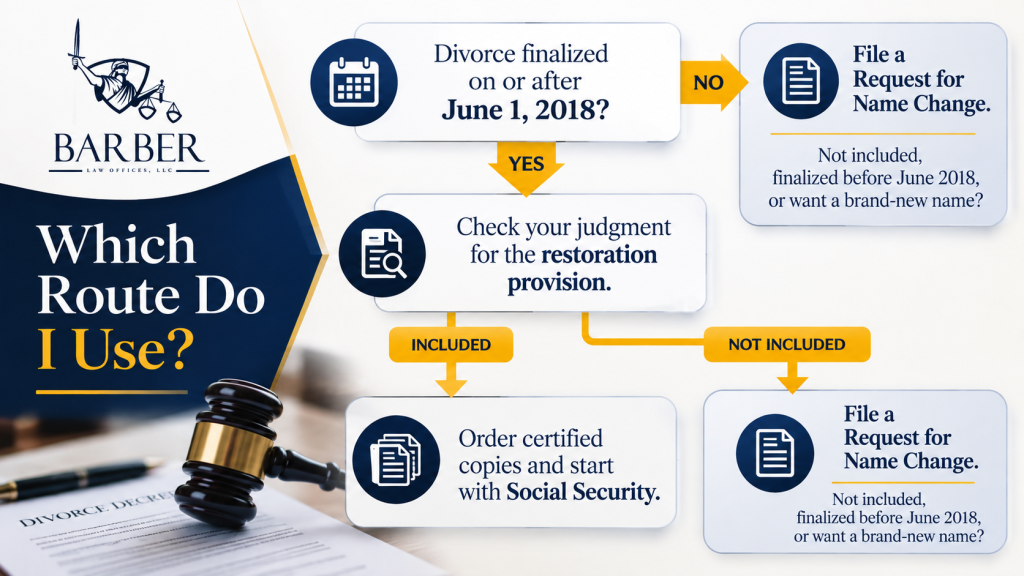
If your divorce is still pending, or your divorce was finalized on or after June 1, 2018, your judgment will generally address name restoration. If your divorce was finalized before June 1, 2018 and your judgment does not restore your former name, you will need to file a separate name change case.
There is one important limit to the divorce route: You can only return to a name you previously held legally, such as your birth name or a surname from an earlier marriage. If you want to take an entirely new last name, you will need to file a separate court petition under the process described in Option 2.
Option 1: Restore Your Name Through Your Divorce Judgment
How It Works Under Current Illinois Law
Under 750 ILCS 5/413(c), a judgment of dissolution must include a provision authorizing you to resume your former or maiden name unless you request otherwise. You don’t have to justify the choice, and you don’t have to act on it right away. The provision lets you resume the name at any time you choose, so it’s still usable five years after your divorce if you decide later.
If your judgment contains that provision, the statute says you don’t need to file a separate name change petition, and you don’t need to publish notice of the change. There’s no added filing fee. The rule is written in gender-neutral terms, so it applies equally to same-sex couples and to anyone whose marriage is declared invalid.
This is a change from older practice. Before June 1, 2018, the court restored a former name only if you specifically asked for it, so an older judgment may say nothing about your name. A 2020 amendment then confirmed you don’t need a separate petition or a newspaper notice.
What Your Judgment Should Say
The default provision often refers generally to your “former or maiden name.” That’s legally sufficient, but in practice it helps to have the judgment state the exact name you’re restoring, spelled out in full. Social Security and the Secretary of State compare your documents line by line, and a judgment that names “Jane Marie Doe” leaves less room for a clerk to push back than one that only refers to a former name.
Before your judgment is entered, check the spelling against your birth certificate or prior marriage records. Correcting a typo afterward requires going back to court.
Once the judgment is entered, order several certified copies from the Clerk of the Circuit Court. A certified copy carries the clerk’s seal and is the only version agencies will accept as proof of your name change. A plain photocopy will be rejected. Social Security may hold onto your copy while it processes your application, so having extras keeps you from stalling out while you wait for it to come back.
Still going through your divorce? Attorney Allen S. Gabe can make sure your judgment names the exact name you’re restoring, so you aren’t sent back to court later. Call 847-303-9780.
Option 2: Filing a Name Change Petition After Your Divorce Is Final
Who Can File in Illinois
Under 735 ILCS 5/21-101, you can file a Request for Name Change if you are an Illinois resident and have lived in the state for at least three months by the time of your hearing or the entry of the order. You must file in the circuit court of the county where you live.
For Cook County residents, including Schaumburg, Hoffman Estates, Palatine, and Arlington Heights, name change requests are e-filed with the County Division of the Circuit Court at the Richard J. Daley Center. Cook County requires electronic filing, so check with the Clerk’s office or your attorney before submitting.
How Illinois Name Change Law Changed in 2024 and 2025
Two recent Illinois laws significantly changed the name change process. As a result, many older guides and articles available may be outdated and give you incorrect information about the current requirements.
Public Act 102-1133 took effect January 1, 2024. Previously, a person with a felony conviction had to wait 10 years after completing a sentence before petitioning for a name change. Now, a person may file once the sentence has been completed, terminated, or discharged, or once the offense has been pardoned. The law also required Illinois courts to use statewide standardized name change forms.
Public Act 103-1063 followed on March 1, 2025. It repealed the newspaper publication requirement entirely, reduced the residency requirement from six months to three, and created a process for asking the court to impound (seal) your file if public disclosure of your name change would put your health or safety at risk. That last option matters for survivors of domestic abuse who don’t want a former spouse tracking a new name through court records.
Do You Have to Publish a Notice in the Newspaper?
Illinois repealed its newspaper publication requirement for name changes, 735 ILCS 5/21-103, effective March 1, 2025. That applies whether you’re restoring a former name through your divorce or filing a standalone petition. Section 413(c) of the divorce statute separately confirms that resuming a former or maiden name after a divorce doesn’t require publication.
If you find a guide telling you to run a notice in a local paper for three weeks, or to file a hardship waiver to skip it, it was written under the old law.
Which Forms Do You Need?
Every Illinois circuit court must accept the Illinois Supreme Court’s standardized name change forms. The current adult forms, approved in March 2025, include:
- How to Change Your Name (instructions)
- Request for Name Change
- Order for Name Change
- Motion to Impound and Order to Impound (optional, only if you want the file sealed)
The forms are free on the Illinois Courts website, and Illinois Legal Aid Online offers a free guided interview that fills them out based on your answers. The Request includes a sworn statement about any criminal history, so read it carefully before you sign.
How Much Does It Cost to Change Your Name After Divorce in Illinois?
The cost depends on which path you take.
- Through your divorce judgment: There is no additional court filing fee for restoring your name through the divorce. You will pay the clerk’s fee for certified copies of your judgment, plus any fees charged by government agencies for updating your records.
- Through a standalone petition: In Cook County, the Clerk of the Circuit Court currently lists a $388 filing fee for a name change petition. Filing fees vary by county. You will also need to pay for certified copies of the signed name change order.
The agency costs are generally the same either way. A corrected Social Security card is free. A corrected Illinois driver’s license costs $5, while a corrected state ID costs $10 for adults ages 18 to 64. Passport fees vary depending on the application or form you file.
If you cannot afford the court costs, Illinois provides a statewide Application for Waiver of Court Fees. Depending on your income or participation in certain public benefits, you may qualify to have eligible court fees waived.
How Long Does an Illinois Name Change Take?
A name change can be relatively quick, but the timeline depends on whether you restore your name through your divorce or file a separate petition. The court process is only part of the timeline. You’ll also need to update your government records afterward.
- Through your divorce: Your right to resume your former name takes effect when the judgment is entered, so it tracks your overall divorce timeline. An uncontested divorce can wrap up much faster than a contested one.
- Through a standalone petition: Most cases move from filing to a signed order in roughly one to three months, depending on the court’s calendar. The statute doesn’t require a hearing in every adult case, but many courts schedule one, and a judge can set another date if more information is needed.
Updating your records adds several more weeks after that. Social Security, the Secretary of State, and the passport office each have their own processing times, and you must do them in order.
Who to Notify After Your Name Change Is Approved
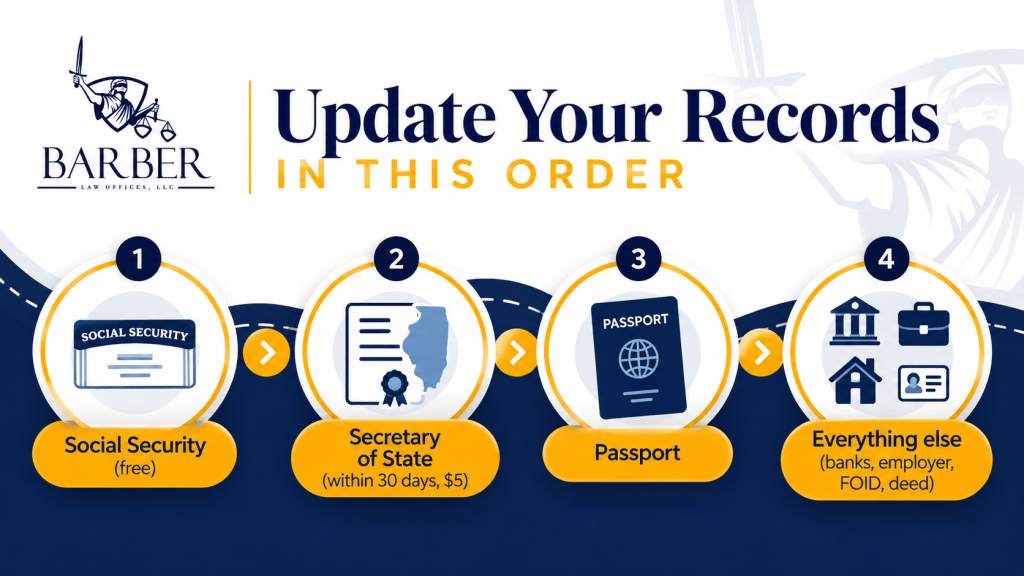
A court order legally changes your name, but it does not automatically update your name with government agencies, financial institutions, or other organizations. The order in which you update your records matters because each agency may require proof that your name has already been changed with another agency.
Start with Social Security
Social Security comes first because almost everything else verifies against its records. The Secretary of State checks your name with the SSA during your visit, and your employer’s payroll and the IRS match your name to your Social Security number. If those records disagree, you can run into rejected applications or tax filing problems.
You can start a corrected card application online through the SSA’s website. If you can’t complete it online, you’ll fill out Form SS-5 and bring your documents to a local Social Security office by appointment. You’ll need proof of identity, a certified copy of your divorce judgment or name change order, and possibly proof of citizenship or lawful immigration status. There’s no fee.
Then the Illinois Secretary of State
Once Social Security has updated your record, visit a Secretary of State Driver Services facility in person. Illinois law requires you to apply for a corrected license within 30 days of a legal name change. Name changes can’t be done online or by mail. Bring your current license or ID, a certified copy of your judgment or order, and payment for the corrected card. If you’re applying for a REAL ID and your birth certificate shows a different name than the one you’re restoring, bring documents that link the names together, such as your marriage certificate and divorce judgment.
You can also update your voter registration during the same visit.
Everything Else
With a new Social Security card and license in hand, work through the rest:
- U.S. passport: Form DS-5504 if your passport was issued less than a year ago, Form DS-82 if you qualify to renew by mail, or Form DS-11 in person otherwise
- Vehicle title and registration through the Secretary of State
- FOID card: Illinois requires a corrected card within 30 days of a legal name change. The fee is $5.
- Banks, credit cards, and loans
- Employer, payroll, and benefits
- Insurance policies (health, auto, home, life)
- Retirement, pension, and brokerage accounts
- Medical providers, schools, and professional licenses
While you’re updating retirement and insurance accounts, check your beneficiary designations too. Divorce doesn’t automatically remove an ex-spouse from every account.
Don’t Forget Your Deed and Mortgage
Real estate is one of the records people most often overlook. A recorded deed does not automatically update when your name changes. Your property will remain under your former name in the county’s records until a new document is recorded.
You may not need to address this immediately, but it can become important when you sell or refinance the property. The title company will need to establish the connection between your former and current names, usually with a certified copy of your judgment and, in some cases, a newly recorded deed. Recording a document with the county typically involves a fee.
If your divorce awards you the marital home and your former spouse is transferring their interest to you, that may be a good time to address the name issue as part of the same process. Our real estate law team can review your deed and mortgage and explain whether anything needs to be recorded now.
Can You Change Your Child’s Last Name After a Divorce?
Not automatically. Restoring your own name does not change your children’s names, and a divorce judgment generally does not change them either.
To change a minor child’s name, you must file a separate request under Illinois’ name change law. The other parent must receive notice, and the court will approve the change only if it finds by clear and convincing evidence that the change is necessary to serve the child’s best interests. Judges may consider both parents’ wishes, the child’s own wishes and reasons for the change, the child’s relationships with family members, and how well the child is adjusted at home, school, and in the community.
That is a higher standard than many parents expect, and name-change requests can become contested. If you are considering changing your child’s last name, talk with a child custody attorney before filing.
| Comparison | Through Divorce Judgment | Separate Name Change Request |
|---|---|---|
| New court case | No | Yes |
| Court filing fee | None | $388 in Cook County |
| Newspaper notice | No | No |
| Can take a brand-new name | No | Yes |
| Typical timing | When judgment is entered | About 1 to 3 months |
What If You Were Divorced in Another State but Live in Illinois?
If your out-of-state judgment restored your former name, most agencies will accept a certified copy of it as proof. Social Security and the Secretary of State look at the document, not where it was issued.
If your judgment didn’t address your name, or an agency refuses to accept it, you can file a Request for Name Change in Illinois once you’ve lived here for three months. You’d file in the circuit court of the county where you now live.
Mistakes That Delay an Illinois Name Change
- Assuming your judgment includes the restoration: Read it, especially if your divorce was finalized before June 1, 2018 or you remember opting out.
- Ordering only one certified copy: Several agencies need to see one, and some hold it for weeks.
- Going to the Secretary of State before Social Security: The SOS checks SSA records, and a mismatch means a wasted trip.
- Misspelling the restored name: A typo in the judgment or petition follows you to every agency until a court corrects it.
- Following outdated online guides: Newspaper publication and the six-month residency rule no longer apply.
- Forgetting the deed and vehicle title: Both stay in your old name until you update them.
Talk to a Schaumburg Divorce Attorney

Restoring your name is usually the easy part of a divorce, but only if the paperwork is right the first time. At Barber Law Offices, attorney Allen S. Gabe helps clients throughout Schaumburg and the northwest suburbs make sure their judgment covers the details that cause problems later, from the exact name being restored to how the marital home is titled.
Whether you’re starting the process of a divorce, need to change something in an existing judgment through a post-decree modification, or want help with a standalone name change, call 847-303-9780 or contact us online to schedule a consultation.
Changing Last Name After Divorce FAQs
Do I have to change my name back after a divorce in Illinois?
No. Restoring your former or maiden name is optional. Judgments entered since June 1, 2018 include a provision that lets you resume your former name at any time you choose, so you can keep your married name now and change it years later without returning to court.
Can I change my name to something completely new during my divorce?
Not through the divorce judgment. Section 413(c) only lets you resume a former or maiden name you previously held legally. To take an entirely new name, you’d file a separate Request for Name Change in the circuit court of the county where you live.
Do I need my ex-spouse’s permission to change my name back?
No. Your ex-spouse doesn’t need to consent, and they can’t block you from restoring your own former name. Changing your children’s names is different and requires notice to the other parent.
What if I forgot to request my maiden name in the divorce?
If your divorce was finalized on or after June 1, 2018, check your judgment first. It likely includes the restoration provision by default. If it doesn’t, or your divorce predates June 1, 2018, you can file a standalone Request for Name Change using the Illinois Supreme Court’s standardized forms, with no newspaper publication required.
Do I have to publish my name change in the newspaper in Illinois?
No. Illinois repealed its newspaper publication requirement for name changes effective March 1, 2025. Restoring a former name through a divorce judgment has not required publication since 2020.
Can I keep my married name after divorce in Illinois?
Yes. Nothing requires you to change it, and your ex-spouse can’t force you to. If your judgment includes the restoration provision, you can still use it later.
Do I need to change my birth certificate?
No. A divorce doesn’t change your birth certificate, and if you’re restoring your birth name, it already matches.

Allen Gabe is an experienced Illinois attorney specializing in family law, bankruptcy, and real estate matters. With over 50 years of experience, he has helped countless clients navigate divorce, child custody, debt relief, and complex legal challenges with compassion and expertise. Recognized for his dedication, Allen has received multiple awards for client satisfaction and is an active member of professional and community organizations in the Chicago suburbs.

