
What Is an Annulment in Illinois? Requirements, Grounds & How to File
If you are considering ending your marriage, you may be wondering whether you qualify for an annulment in Illinois. An annulment, legally known as a Declaration of Invalidity of Marriage, is a court judgment declaring that a marriage was legally invalid. Unlike a divorce, which ends a legally valid marriage, an annulment addresses a legal defect that existed when the marriage took place.
Illinois law recognizes only four grounds for an annulment: lack of capacity to consent, inability to consummate the marriage, an underage marriage without the required consent, or a marriage prohibited by law. Each ground has specific filing deadlines and legal requirements under the Illinois Marriage and Dissolution of Marriage Act (750 ILCS 5/301–302).
To obtain an annulment, you must establish that your circumstances meet one of these statutory grounds, file within the applicable deadline, and provide evidence supporting your claim. Some deadlines are as short as 90 days after discovering the issue.
Understanding these requirements is important before taking legal action. Below, we explain what qualifies for an annulment in Illinois, what documentation you may need, how the process works, and what happens after a judge grants a declaration of invalidity.
What Is an Annulment in Illinois?
An annulment in Illinois is a court judgment declaring a marriage invalid because it meets one of the specific legal grounds established by state law.
Under Section 301 of the Illinois Marriage and Dissolution of Marriage Act, a judge can enter a judgment declaring a marriage invalid when certain legal circumstances existed at the time of the marriage ceremony. Although people commonly use the word “annulment,” Illinois courts refer to the process as a Declaration of Invalidity of Marriage.
The distinction between an annulment and a divorce is important:
- Annulment: A court determines that the marriage was legally invalid based on a qualifying legal ground.
- Divorce: A court ends a legally valid marriage because irreconcilable differences have caused its breakdown.
An annulment is not automatically available because a marriage was short, unsuccessful, or entered into impulsively. Illinois courts require specific legal grounds before granting one.
Annulment vs. “Declaration of Invalidity”: Why Does Illinois Use a Different Term?
Illinois law uses the term Declaration of Invalidity of Marriage rather than simply annulment. Section 301 of the Illinois Marriage and Dissolution of Marriage Act specifically identifies the legal grounds for declaring a marriage invalid and refers to the process as formerly known as annulment.
If you pursue this type of case, you will generally file a Petition for Declaration of Invalidity of Marriage rather than a traditional divorce petition. The terms are commonly used interchangeably, but understanding the official terminology can help you find the correct court forms and legal information.
Civil Annulment vs. Religious Annulment
A civil annulment and a religious annulment are two separate processes with different requirements and legal effects.
- A civil annulment is granted by a judge and determines whether a marriage is legally valid under Illinois law.
- A religious annulment is granted by a religious organization or tribunal and determines whether a marriage meets that organization’s religious requirements.
For example, someone seeking a Catholic annulment may need to go through a diocesan tribunal. However, a religious annulment does not change a couple’s legal marital status. If you want to legally end your marriage, you must obtain a civil annulment or divorce through the court system, even if you have already received a religious annulment.
What Do You Need to Get an Annulment in Illinois?
To obtain an annulment in Illinois, you must establish one of four legal grounds under 750 ILCS 5/301, meet the applicable filing deadline, have legal standing to bring the case, and provide sufficient evidence to support your claim.
A judge cannot grant an annulment simply because both spouses agree that they want the marriage declared invalid. The court must determine that the legal requirements have been satisfied.
| Requirement | What It Means |
|---|---|
| Legal grounds | Your circumstances must meet one of the four grounds under Section 301. |
| Filing deadline | You must file within the time limit established by Section 302. |
| Legal standing | You must be someone authorized by law to bring the petition. |
| Supporting evidence | You must provide evidence establishing the legal grounds for the annulment. |
There is no general minimum or maximum length of marriage required to request an annulment. However, the length of the marriage does not determine eligibility. The circumstances surrounding the marriage and the applicable filing deadline are what matter.
What Are the 4 Legal Grounds for Annulment in Illinois?
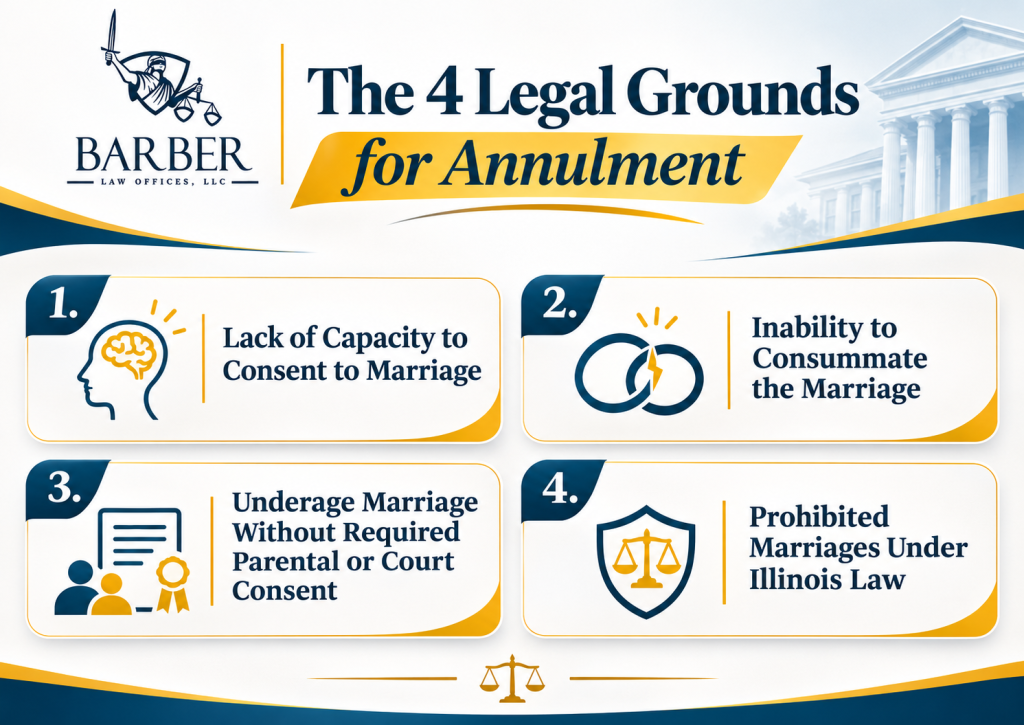
Illinois recognizes only four legal grounds for declaring a marriage invalid. These grounds are outlined in Section 301 of the Illinois Marriage and Dissolution of Marriage Act. Understanding which ground applies to your situation is the first step in determining whether an annulment may be possible.
1. Lack of Capacity to Consent to Marriage
One ground for an annulment is that a spouse lacked the legal capacity to consent to the marriage when the ceremony took place.
Under Illinois law, this can involve:
- Mental incapacity or infirmity.
- The influence of alcohol, drugs, or another incapacitating substance.
- Force or duress that caused someone to enter into the marriage.
- Fraud involving the essentials of marriage.
For example, someone who was so impaired by alcohol or drugs that they could not understand they were entering into a marriage may have grounds to seek an annulment. Similarly, someone who entered into a marriage because of force or threats may qualify under this provision.
2. Inability to Consummate the Marriage
A marriage may be declared invalid if one spouse lacked the physical capacity to consummate the marriage through sexual intercourse and the other spouse did not know about the incapacity when they married.
There are two important requirements:
- One spouse must have lacked the physical capacity to consummate the marriage.
- The other spouse must have been unaware of that incapacity when the marriage took place.
This ground focuses on physical incapacity, not simply a lack of desire or unwillingness to engage in sexual intercourse. For example, if someone discovers after getting married that their spouse had a physical condition preventing consummation, and they did not know about the condition before the wedding, they may have grounds to request an annulment. Infertility alone does not establish this ground because the statute specifically addresses physical capacity to consummate the marriage.
Important filing deadline: The petition must generally be filed within one year after discovering the incapacity.
3. Underage Marriage Without Required Parental or Court Consent
Illinois law generally requires individuals to be at least 18 years old to marry without additional consent. Under Section 203 of the Illinois Marriage and Dissolution of Marriage Act, individuals who are 16 or 17 may marry with the required parental or guardian consent or judicial approval. If someone who was 16 or 17 entered into a marriage without the required consent or court approval, the marriage may qualify for a declaration of invalidity. The law also identifies circumstances involving an unavailable parent and the required documentation of efforts to locate that parent.
Important filing deadline: The underage spouse, their parent, or their guardian must file before the underage spouse reaches the age at which they could have married without the omitted requirement, generally age 18.
4. Prohibited Marriages Under Illinois Law
Illinois law prohibits certain marriages under Section 212 of the Illinois Marriage and Dissolution of Marriage Act. If a marriage falls into one of these prohibited categories, it may qualify for a declaration of invalidity.
Prohibited marriages include:
- A marriage entered into before an earlier marriage or civil union was legally dissolved (bigamy)
- A marriage between an ancestor and a descendant, or between siblings, whether related by half blood, whole blood, or adoption
- A marriage between an uncle or aunt and a niece or nephew
- A marriage between first cousins, unless both are 50 or older or one of them is permanently and irreversibly sterile
There is an important exception involving prohibited marriages. Under Section 212(b), if the legal obstacle preventing a marriage is removed and the couple continues living together, the marriage becomes legally recognized as of the date the obstacle was removed. For example, if someone marries before their previous divorce is finalized, the marriage is initially prohibited. However, if the previous divorce becomes final and the couple continues cohabiting, the new marriage becomes legally valid from the date the prior divorce was finalized.
Important filing deadline: A declaration of invalidity based on a prohibited marriage may be requested during the parties’ lifetimes. If a party has died, Section 302(c) allows an eligible person to bring the action within three years following the death of the first party to die.
How Long Do You Have to Get an Annulment in Illinois?
The filing deadline for an annulment in Illinois depends on the legal ground supporting the petition. Section 302 of the Illinois Marriage and Dissolution of Marriage Act establishes different time limits for each ground.
| Legal Ground | Filing Deadline |
|---|---|
| Lack of capacity, force, duress, or qualifying fraud | Within 90 days after discovering the condition |
| Inability to consummate the marriage | Within one year after discovering the incapacity |
| Underage marriage without required consent | Before the underage spouse reaches the age at which consent is no longer required |
| Prohibited marriage | During the parties’ lifetimes or, following a party’s death, within three years after the first party to die |
The filing deadlines are especially important because missing the applicable deadline can prevent someone from obtaining an annulment.
Not sure whether your 90 days have already started? Attorney Allen S. Gabe can review your timeline and tell you where you stand. Call 847-303-9780.
Does the Filing Deadline Start on the Wedding Date?
Not necessarily. For lack of capacity, force, duress, or fraud, the 90-day deadline generally begins when the person filing learns of the condition. For inability to consummate the marriage, the one-year period begins when the petitioner learns of the incapacity. The underage marriage ground has a different deadline tied to the underage spouse’s age. This means that the wedding date alone does not determine whether someone can still request an annulment.
For example, someone who has been married for five years may still have a potential claim if they only recently discovered facts that qualify under the law and are still within the applicable filing period. However, the circumstances must meet the statutory requirements, and other restrictions may apply.
Can You Get an Annulment After One Year in Illinois?
Sometimes. The one-year deadline applies specifically to annulments based on a spouse’s inability to consummate the marriage. It does not apply to every type of annulment. A claim involving qualifying fraud, force, duress, or lack of capacity generally has a 90-day discovery deadline instead.
Prohibited marriages are subject to different rules. It is important to identify the correct legal ground before determining whether you are still within the filing period.
What Documents Do You Need to File for an Annulment in Illinois?
The documentation needed for an annulment depends on the circumstances and the legal ground supporting the petition. Although there is no universal document checklist for every case, gathering relevant records can help establish what happened and when you discovered the issue.
Potentially useful documents include:
- Marriage certificate and information about the date and location of the marriage.
- Identification and basic information about both spouses.
- Medical or psychiatric records related to incapacity, when relevant.
- Text messages, emails, or other communications supporting claims of fraud, force, or duress.
- Police reports or orders of protection, if applicable.
- Prior marriage records and divorce judgments when bigamy is involved.
- Birth certificates, adoption records, or other documentation establishing prohibited family relationships.
- Marriage license applications or records concerning missing parental or judicial consent.
- Messages, records, or witness information establishing when you discovered the issue.
The specific evidence needed will depend on the facts of the case. For example, someone alleging that their spouse was already married may need records showing the prior marriage and whether a divorce judgment existed before the subsequent wedding. Someone alleging force or duress may need communications, police reports, or witness testimony supporting the circumstances surrounding the marriage.
Why Is the Date You Discovered the Problem Important?
For several annulment grounds, the filing deadline begins when the petitioner learns about the condition. This makes documenting the discovery date particularly important. Preserving relevant text messages, emails, medical records, and other communications can help establish when you became aware of the issue. An attorney can help evaluate which documents are relevant and how they may be used to support your petition.
How Long Does an Annulment Take in Illinois?
There is no single timeline for completing an annulment in Illinois. The duration depends on the circumstances of the case, the court’s schedule, and whether the other spouse contests the petition.
Several factors can influence how long the process takes:
- Whether the case is contested: If both parties agree, the case may involve fewer disputes. However, the judge must still determine that a legal ground exists.
- Available evidence: Gathering medical records, court documents, witness testimony, or other supporting evidence may take additional time.
- Court scheduling: Hearing dates and court availability can affect the overall timeline.
- Additional legal issues: Property, maintenance, and parenting issues may require further court proceedings.
Even if both spouses agree that they want an annulment, the court cannot grant one without sufficient legal grounds. An attorney can help evaluate the circumstances and explain what to expect based on the complexity of the case.
Annulment vs. Divorce in Illinois: What’s the Difference?
An annulment and a divorce both address the legal status of a marriage, but they have different requirements and consequences. An annulment declares a marriage invalid based on specific legal grounds. A divorce in Illinois ends a legally valid marriage.
Here is how the two processes compare:
| Comparison | Annulment | Divorce |
|---|---|---|
| Legal terminology | Declaration of Invalidity of Marriage | Dissolution of Marriage |
| Legal effect | Declares the marriage invalid, subject to the court’s retroactivity determination | Legally ends a valid marriage |
| Grounds required | One of four grounds under 750 ILCS 5/301 | Irreconcilable differences under 750 ILCS 5/401 |
| Filing deadlines | Specific deadlines apply depending on the grounds | No comparable 90-day or one-year annulment deadline |
| Property rights | Depend on retroactivity and potential putative spouse rights | Governed by Illinois divorce property-division laws |
| Spousal maintenance | May be available under the putative spouse provisions or applicable non-retroactive judgment rules | May be awarded under Illinois law |
| Children | Their legal status is protected under Illinois law | Parenting and support issues are addressed in the divorce |
| Legal requirements | Must establish a qualifying statutory ground | Must establish the statutory requirements for dissolution |
When Should You Consider an Annulment?
An annulment may be appropriate when your circumstances meet one of the four statutory grounds, and you are within the applicable filing deadline. Some individuals may also have personal or religious reasons for wanting a marriage declared invalid rather than obtaining a divorce.
However, an annulment is not necessarily the better option simply because someone wants the marriage treated as though it never existed. The legal and financial consequences can be significant, particularly when property, debt, children, or spousal support are involved.
When Is Divorce the Better Option?
If your circumstances do not meet one of the four legal grounds for annulment, divorce is generally the appropriate way to end the marriage. Illinois is a no-fault divorce state. Under Section 401, a court may grant a divorce when irreconcilable differences have caused the irretrievable breakdown of the marriage and the statutory requirements are satisfied. You do not need to prove that your spouse cheated, lied, or did something wrong to obtain a divorce.
In some circumstances, it may also be possible to pursue a declaration of invalidity and request dissolution of marriage as an alternative in the same proceeding. Cook County recognizes a combined filing option for a Petition for Declaration of Invalidity or, in the Alternative, Dissolution of Marriage. An attorney can help determine whether this approach is appropriate for your circumstances.
What Happens After an Annulment Is Granted in Illinois?
Once a judge enters a judgment declaring a marriage invalid, several legal and financial considerations may still need to be addressed. Illinois law specifically addresses children, retroactivity, property rights, and the rights of putative spouses. These issues are important because an annulment does not automatically eliminate every legal responsibility or financial consideration associated with the relationship.
Children, Parenting, and Child Support
Under Section 303 of the Illinois Marriage and Dissolution of Marriage Act, children born or adopted during a marriage that is later declared invalid are considered the lawful children of both parties.
An annulment does not eliminate a parent’s legal relationship or responsibilities toward their children. Issues involving parenting time, allocation of parental responsibilities, and child support may still need to be addressed by the court.
Property, Debts, and Retroactivity
Under Section 304, an Illinois court generally declares a marriage invalid as of the date of the marriage unless the judge determines that making the judgment non-retroactive would better serve the interests of justice. When making that determination, the court considers relevant circumstances, including the potential effect on third parties. This distinction can significantly affect property and financial rights.
- Retroactive judgment: When a judgment is retroactive, the marriage is generally treated as invalid from the date it took place. The statutory provisions governing property division and maintenance between spouses on dissolution do not apply through Section 304 in the same way they would to a non-retroactive judgment.
- Non-retroactive judgment: When the court determines that a non-retroactive judgment is appropriate, the applicable statutory provisions concerning property, maintenance, child support, and parental responsibilities may apply.
For example, if a couple purchased a home together, accumulated debt, or made significant financial contributions during the relationship, the court’s determination regarding retroactivity may have important consequences.
These issues should be reviewed with an attorney before filing because the requested relief and the circumstances of the relationship may affect the court’s decision.
Can You Receive Spousal Support? Understanding the Putative Spouse Rule
An annulment does not necessarily eliminate every possibility of receiving financial support. Illinois recognizes a legal concept known as a putative spouse under Section 305 of the Illinois Marriage and Dissolution of Marriage Act.
A putative spouse is someone who went through a marriage ceremony, lived with the other person, and believed in good faith that they were legally married. A person who meets these requirements may acquire certain rights similar to those of a legally married spouse, including potential rights to maintenance.
For example, consider someone who marries another person in good faith, lives with that person for several years, and later discovers that their spouse never legally finalized a previous divorce. The marriage may be prohibited because the spouse was still legally married to someone else. However, the person who entered the marriage in good faith may qualify as a putative spouse. The court may then consider their rights to property, maintenance, and support.
There are important limitations:
- A marriage ceremony and cohabitation are required.
- The person must have entered the relationship with a good-faith belief that the marriage was legally valid.
- Putative spouse status ends when the person learns that the marriage is not legally valid, and they generally cannot acquire additional rights after that point.
- If another legal spouse or putative spouse has competing rights, the court may need to apportion property, maintenance, and support.
The putative spouse rule can be particularly important in cases involving bigamy or other prohibited marriages.
How to File for an Annulment in Cook County, Illinois
If you live in Schaumburg or another northwest suburban community, your annulment case may be handled through the Circuit Court of Cook County. An annulment generally follows the procedures used for other civil and domestic relations cases, although the specific documents and court requirements depend on the circumstances.
1. Prepare a Petition for Declaration of Invalidity of Marriage
The petition generally identifies both spouses, the date and location of the marriage, the applicable legal ground under Section 301, and the facts supporting the request. It should also address relevant issues involving children, property, and the relief requested.
2. File the Petition With the Circuit Court
Cook County requires certain supporting documents for new domestic relations cases, including a Domestic Relations Cover Sheet and a Certificate of Dissolution or Invalidity of Marriage. Eligible filings are generally submitted electronically.
3. Serve Your Spouse
The other spouse must receive proper legal notice of the case through service of process. The petitioner generally cannot personally serve the summons and petition.
4. Allow the Other Spouse to Respond
The other spouse has an opportunity to respond to the petition. In Cook County, the standard summons generally provides 30 days after service for the respondent to file an appearance and response.
5. Attend the Court Hearing
The judge reviews the petition, supporting documentation, and relevant testimony. Even if the other spouse agrees, the petitioner must establish that the legal requirements for an annulment have been satisfied.
6. Obtain the Final Judgment
If the judge determines that the requirements have been met, the court enters a Judgment for Declaration of Invalidity of Marriage. Certified copies should be obtained for your records and any necessary administrative updates.
Filing fee: The Clerk of the Circuit Court of Cook County lists a $388 fee for filing a new case in the Domestic Relations Division, and that includes a Petition for Declaration of Invalidity. If you can’t afford it, you can apply for a waiver of court fees.
If you’ve never been inside a Cook County courtroom, our guide to your first Cook County divorce court appearance explains what the day looks like. Much of it applies to annulment cases too.
Speak With a Schaumburg Family Law Attorney About an Annulment
Determining whether you qualify for an annulment in Illinois requires more than simply identifying a problem in your marriage. You must establish that your circumstances meet one of the four legal grounds, comply with the applicable filing deadline, and provide sufficient evidence to support your petition. The potential consequences can also extend beyond your marital status. Property rights, financial obligations, children, and potential putative spouse protections may all need to be considered.
At Barber Law Offices, attorney Allen S. Gabe helps individuals navigate family law matters, including divorce, property division, child-related issues, and other complex legal concerns. Located in Schaumburg, Barber Law Offices serves individuals and families throughout the northwest suburbs and greater Chicagoland area.
If you are considering an annulment, an attorney can review your circumstances, explain whether you may qualify, and help you understand your available legal options.
Contact Barber Law Offices at 847-303-9780 to discuss your situation and schedule a consultation.
Illinois Annulment FAQs
What qualifies for an annulment in Illinois?
Illinois recognizes four grounds for an annulment under 750 ILCS 5/301: lack of capacity to consent, inability to consummate the marriage, underage marriage without required consent, and prohibited marriages. A short marriage or regret about getting married does not independently qualify.
Can you get an annulment after five years in Illinois?
Possibly. Some deadlines run from the date you discovered the condition rather than the wedding date. For example, qualifying fraud or incapacity generally has a 90-day discovery deadline. Prohibited marriages are subject to different rules.
Is cheating grounds for an annulment in Illinois?
No. Adultery is not one of the four legal grounds for an annulment under Illinois law. Divorce is generally the appropriate option when a spouse is unfaithful. However, if your spouse was legally married to someone else when you married, the marriage may be prohibited.
Do both spouses have to agree to an annulment?
No. One spouse may file a petition without the other’s agreement. However, the petitioner must still prove that the marriage meets one of the legal grounds established under Illinois law.
Can you get an annulment if your spouse lied to you?
Possibly, but not every lie qualifies. Illinois law recognizes fraud involving the essentials of marriage as a potential ground for annulment. Ordinary dishonesty about finances or personal matters does not automatically meet the legal standard.
Can you get an annulment without your spouse knowing?
You may initiate an annulment case without your spouse’s agreement, but you generally cannot proceed without providing legally required notice and service of process. The court may consider a default if the other spouse does not respond, but you must still establish the legal grounds.
Can you remarry after an annulment in Illinois?
Once a judge enters a final judgment declaring the marriage invalid, you are generally free to marry again, subject to applicable legal requirements. Confirm that the final judgment has been entered before making plans to remarry.
Does an annulment affect property or assets?
Yes. Financial consequences can depend on whether the judgment is retroactive or non-retroactive and whether either person qualifies as a putative spouse. A non-retroactive judgment may allow the court to address property, maintenance, child support, and parenting matters under applicable Illinois law.
Is a religious annulment the same as a legal annulment?
No. A religious annulment is handled by a religious organization and does not change your legal marital status. A civil annulment is granted by a court and determines whether a marriage is legally valid under Illinois law.
Can an out-of-state marriage be annulled in Illinois?
Potentially. The fact that a marriage took place outside Illinois does not automatically prevent an Illinois court from considering a declaration of invalidity. The court must have appropriate jurisdiction, and the petitioner must establish a qualifying legal ground.